
EB-2 Visa Attorney in West Palm Beach
Employment-Based Green Cards for Advanced Degree Professionals and Individuals With Exceptional Ability
For professionals who have built significant education, experience, or expertise in their field, the EB-2 employment-based immigrant category can provide a path to lawful permanent residence in the United States.
But qualifying for EB-2 classification is only one part of the process.
Some applicants need an employer willing to sponsor them and complete the PERM labor certification process. Others may qualify for a National Interest Waiver (NIW), which can eliminate the job offer and labor certification requirements and allow the individual to self-petition.
Determining which path applies requires looking closely at your education, professional experience, accomplishments, proposed work in the United States, immigration history, and long-term goals.
AtAsghar Law, established in 2014, our West Palm Beach immigration attorneys help professionals, employers, entrepreneurs, and other qualified applicants understand their options and navigate the employment-based immigration process.
Call (561) 609-0032 to schedule a consultation directly with an attorney. Our multilingual team serves clients in English, Spanish, Creole, French, Arabic, and Portuguese.
What Is an EB-2 Green Card?
EB-2 is the second-preference employment-based immigrant classification for two primary groups: members of professions who hold advanced degrees and individuals with exceptional ability in the sciences, arts, or business.
Unlike temporary employment visas, the EB-2 category is an immigrant classification, meaning the ultimate objective is lawful permanent residence, aka Green Card.
There are two important questions at the beginning of an EB-2 case:
- Do you meet the requirements for EB-2 classification?
- Will your case require employer sponsorship and PERM, or could you qualify for a National Interest Waiver?
The answers determine how the case is structured and what evidence will be required.
Who Qualifies for an EB-2 Green Card?
There are two primary bases for establishing EB-2 eligibility.
Advanced Degree Professionals
An applicant may qualify as an advanced degree professional based on an advanced U.S. degree or foreign equivalent.
A bachelor's degree or foreign equivalent followed by at least five years of progressive post-baccalaureate experience in the specialty may also satisfy the advanced-degree standard.
For employer-sponsored cases, the position itself must also satisfy the applicable requirements for the EB-2 classification.
Individuals With Exceptional Ability
The second path is for individuals who can demonstrate exceptional ability in the sciences, arts, or business.
Exceptional ability means expertise significantly above what is ordinarily encountered in the person's field.
Evidence can involve education, substantial professional experience, licenses or certifications, compensation, professional memberships, recognition for achievements, and other comparable evidence depending on the applicant's background.
Meeting the basic EB-2 classification, however, does not automatically mean someone qualifies for a National Interest Waiver.
Those are separate analyses.
What Is the Difference Between EB-2 and EB-2 NIW?
EB-2 is the underlying employment-based immigrant classification.
An EB-2 National Interest Waiver, commonly called an EB-2 NIW, is a way for an eligible EB-2 applicant to ask the government to waive the usual job-offer and labor-certification requirements because granting the waiver would benefit the United States.
In a traditional employer-sponsored EB-2 case, a U.S. employer generally sponsors the worker and first completes the PERM labor certification process before filing Form I-140. The Department of Labor describes PERM as the process through which it determines, among other things, whether sufficient able, willing, qualified, and available U.S. workers exist for the job opportunity and whether employing the foreign worker would adversely affect similarly employed U.S. workers.
An NIW can eliminate that requirement.
That means a qualifying applicant may self-petition without a sponsoring employer.
This can make the NIW particularly important for researchers, physicians, scientists, entrepreneurs, engineers, technology professionals, academics, business leaders, and others whose proposed work may have broader importance to the United States.
The occupation alone does not determine eligibility. The strength of an NIW case depends on the applicant, the proposed endeavor, and the evidence supporting it.
How Does USCIS Decide an EB-2 National Interest Waiver?
After establishing eligibility for the underlying EB-2 classification, an applicant requesting a National Interest Waiver must address the framework established in Matter of Dhanasar.
Matter of Dhanasar: A 2016 immigration decision that established the three-part legal test USCIS uses to evaluate EB-2 National Interest Waiver (NIW) petitions.
The analysis considers three questions:
- Does the proposed endeavor have substantial merit and national importance?
- Is the applicant well positioned to advance the proposed endeavor?
- On balance, would it benefit the United States to waive the job offer and labor certification requirements?
This is where an NIW petition becomes much more than a résumé and collection of credentials.
A strong petition needs to connect the applicant's background to the work they intend to pursue in the United States and explain why that work matters.
What Evidence Can Support an EB-2 NIW Petition?
There is no single document that establishes a National Interest Waiver.
Evidence will depend on the applicant's profession, accomplishments, and proposed endeavor. Depending on the case, supporting documentation may include:
- Academic degrees and transcripts
- Professional licenses and certifications
- Employment and experience records
- Publications and citations
- Research
- Patents or intellectual property
- Awards and professional recognition
- Evidence of significant contributions to the field
- Media coverage
- Professional memberships
- Recommendation or expert letters
- Contracts or client relationships
- Funding or investment
- Business plans
- Evidence of economic or job-creation potential
- Documentation showing the broader impact of the applicant's work
More evidence does not automatically mean a stronger case.
The evidence needs to tell a coherent story about what you have accomplished, what you intend to do in the United States, why you are positioned to do it, and why the proposed endeavor matters beyond a single employer or client.
What Is the Employer-Sponsored EB-2 Process?
For EB-2 applicants who do not pursue a National Interest Waiver, the process typically begins with employer sponsorship.
The process may include:
1. PERM Labor Certification
The employer generally obtains a prevailing wage determination, completes the required recruitment, and submits the permanent labor certification application to the U.S. Department of Labor. The Department of Labor confirms these as core steps in the PERM process.
Learn More About the PERM Process Here
2. Form I-140
After the required labor certification is approved, the employer files Form I-140, Immigrant Petition for Alien Workers, with USCIS.
The petition must establish that the worker qualifies for the requested classification and that the requirements of the underlying position and petition have been satisfied.
3. Visa Availability
An approved I-140 does not necessarily mean a Green Card is immediately available.
Employment-based immigrant visas are numerically limited, and the applicant's priority date determines their place in line.
The U.S. Department of State publishes the Visa Bulletin each month showing visa availability by employment category and country of chargeability. As of September 2026, the State Department continues to report significant demand in the EB-2 category, illustrating why applicants should not assume I-140 approval means immediate permanent residence.
4. Adjustment of Status or Consular Processing
When an immigrant visa is available and the applicant is otherwise eligible, the final stage generally occurs through one of two routes.
Applicants who are eligible and physically present in the United States may pursue adjustment of status through Form I-485.
Applicants completing the process from outside the United States generally proceed through consular processing for an immigrant visa.
Which route applies depends on the applicant's circumstances.
What Is the EB-2 NIW Process?
An NIW follows a different path because PERM and a permanent job offer can be waived.
A case generally involves:
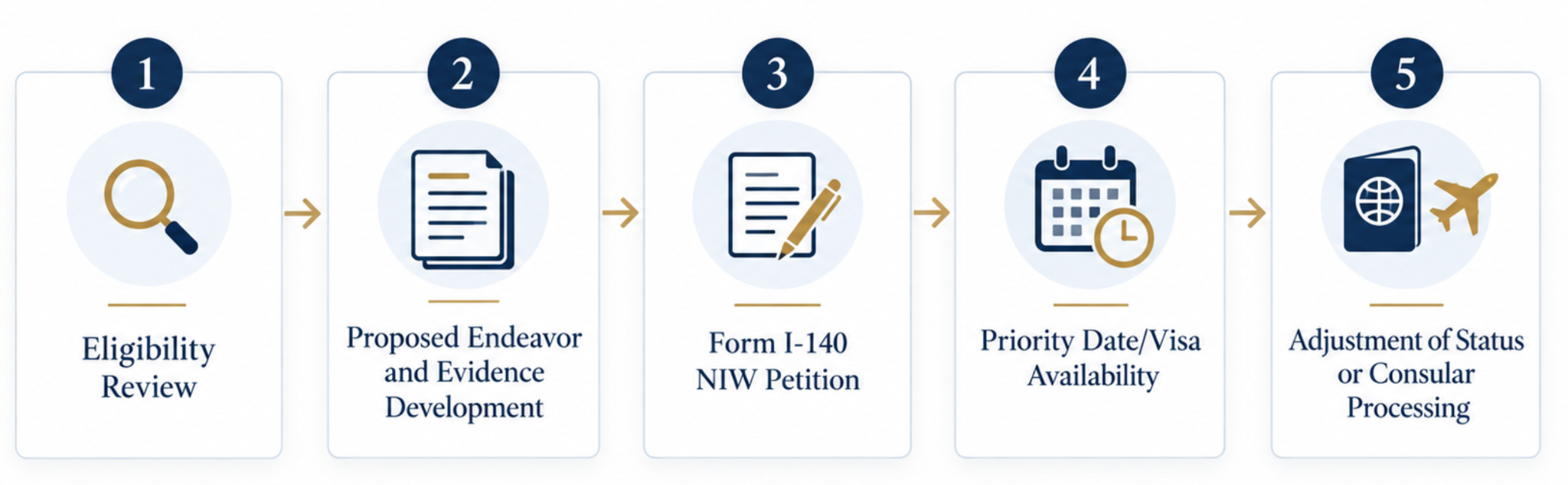
USCIS has also expanded premium processing to qualifying EB-2 NIW Form I-140 petitions. Premium processing accelerates USCIS action on the I-140 petition; it does not eliminate visa-number limitations or guarantee approval of the underlying petition.
That distinction is important when considering the overall timeline.
How Long Does an EB-2 Green Card Take?
There is no single EB-2 timeline.
An employer-sponsored case may involve time for the prevailing wage process, recruitment, PERM adjudication, the I-140 petition, visa availability, and the final Green Card process.
An NIW eliminates PERM, but applicants may still face USCIS processing times and a wait for an immigrant visa number.
Country of chargeability can make a substantial difference.
Visa Bulletin dates also move. They can advance, remain unchanged, or retrogress depending on demand and the number of visas available. The Department of State's September 2026 bulletin, for example, warned that EB-2 demand could require further retrogression or unavailability before the end of fiscal year 2026.
[Visit the Visa Bulletin Here] ← Button
For that reason, evaluate an EB-2 timeline based on the specific applicant and the current Visa Bulletin, rather than a generic estimate found online.
Can Your Spouse and Children Be Included?
Qualifying spouses and unmarried children under age 21 may generally immigrate as derivative beneficiaries of the principal EB-2 applicant.
For professionals considering a long-term future in the United States, this can make the EB-2 process important not only for their career but for their family as well.
Is EB-2 the Right Employment-Based Immigration Option?
Not every highly qualified professional should automatically pursue EB-2.
Depending on the person's credentials, goals, employer, nationality, and proposed work, another immigration category may make more sense. That’s why talking with our team can help guide you through the decision-making process.
Potential alternatives can include other employment-based immigrant classifications, O-1 visas for individuals with extraordinary ability or achievement, and other employment or investment immigration options.
The important question is not simply, “Can I qualify for EB-2?”
It is also, “Which immigration strategy makes the most sense for what I am trying to accomplish?”
That is a question worth answering before significant time and money are invested in a petition.
Why Work With Asghar Law on an EB-2 Case?
Employment-based immigration can involve USCIS, the Department of Labor, the Department of State, an employer, and years of professional history.
Asghar Law has served immigration clients since 2014, giving our team more than a decade of experience helping people navigate the U.S. immigration system.
Founding attorney Shaz Asgharis an immigrant himself, giving him firsthand perspective on what it means to build a life and future in the United States.
Our team works with clients to understand not only whether they meet an immigration classification on paper, but how their education, experience, accomplishments, and future plans fit together as part of a broader immigration strategy.
From our West Palm Beach office, we serve professionals, families, employers, and businesses throughout Palm Beach County, South Florida, Orlando, and beyond.
Frequently Asked Questions About EB-2 Green Cards
Can I apply for an EB-2 Green Card without an employer?
Potentially. Applicants seeking a National Interest Waiver may self-petition and request that the job offer and PERM labor certification requirements be waived. The applicant must first qualify for EB-2 classification and then satisfy the NIW requirements.
Is EB-2 NIW the same thing as EB-2?
No. EB-2 is the underlying employment-based immigrant classification. The National Interest Waiver is a waiver available to certain EB-2 applicants that can remove the usual job offer and labor certification requirements.
Do I need PERM for an EB-2 NIW?
No. One of the central features of a National Interest Waiver is that a qualifying applicant can request a waiver of the labor certification and job offer requirements.
Can I self-petition for EB-2?
A traditional employer-sponsored EB-2 petition generally requires a sponsoring employer. An applicant pursuing an EB-2 National Interest Waiver may file Form I-140 on their own behalf if they satisfy the applicable requirements.
Does having a master's degree automatically qualify me for EB-2 NIW?
No. An advanced degree may help establish the underlying EB-2 classification, but NIW eligibility requires a separate analysis of the proposed endeavor, the applicant's ability to advance it, and whether waiving the job offer and labor certification requirements would benefit the United States.
Can I get premium processing for an EB-2 NIW?
USCIS makes premium processing available for qualifying EB-2 NIW Form I-140 petitions. Premium processing affects the adjudication of the I-140; it does not make a visa number immediately available or guarantee approval. USCIS
What happens after my EB-2 I-140 is approved?
The next step depends on visa availability and where the applicant is located. Eligible applicants in the United States may ultimately pursue adjustment of status, while applicants abroad generally complete immigrant visa processing through a U.S. consulate.
How do I know whether EB-2, EB-2 NIW, or another immigration category is right for me?
That requires reviewing your education, professional history, accomplishments, proposed work, current immigration status, employer situation, country of chargeability, and long-term goals. Two applicants with similar résumés can have very different immigration strategies.
Speak With an EB-2 Green Card Attorney in West Palm Beach
If you are considering an EB-2 Green Card, National Interest Waiver, or employer-sponsored immigration petition, the first step is understanding which path fits your circumstances.
Asghar Law works with professionals, employers, entrepreneurs, and families in West Palm Beach, Palm Beach County, Orlando, throughout South Florida, and beyond.
Call (561) 609-0032 to schedule your consultation with an Asghar Law immigration attorney and discuss your EB-2 options.
Where Legal Solutions and Compassion Converge
Our experienced team goes the extra mile to ensure your needs are met with precision and care. We believe in not only meeting but exceeding your expectations, setting a new standard in the legal field. Experience the difference for yourself and discover why our clients trust us to handle their immigration legal matters. Your journey begins with the extraordinary.
-
A Legacy of TrustEstablished in 2014, Asghar Law boasts a legacy of trust and excellence. Our 10+ years of experience are a testament to our deep understanding of immigration laws and processes.
-
Direct Attorney ConsultationsEvery consultation at our firm is directly with an attorney, ensuring that you receive personalized and expert legal guidance from the very beginning.
-
Multilingual SupportLanguage should never be a barrier. Our team speaks Spanish, Creole, and Arabic, providing comprehensive support to diverse communities.
-
Transparency and Timely UpdatesWe provide continuous updates on your case's progress, coupled with comprehensive explanations of each step and any legal changes that may impact your situation.